
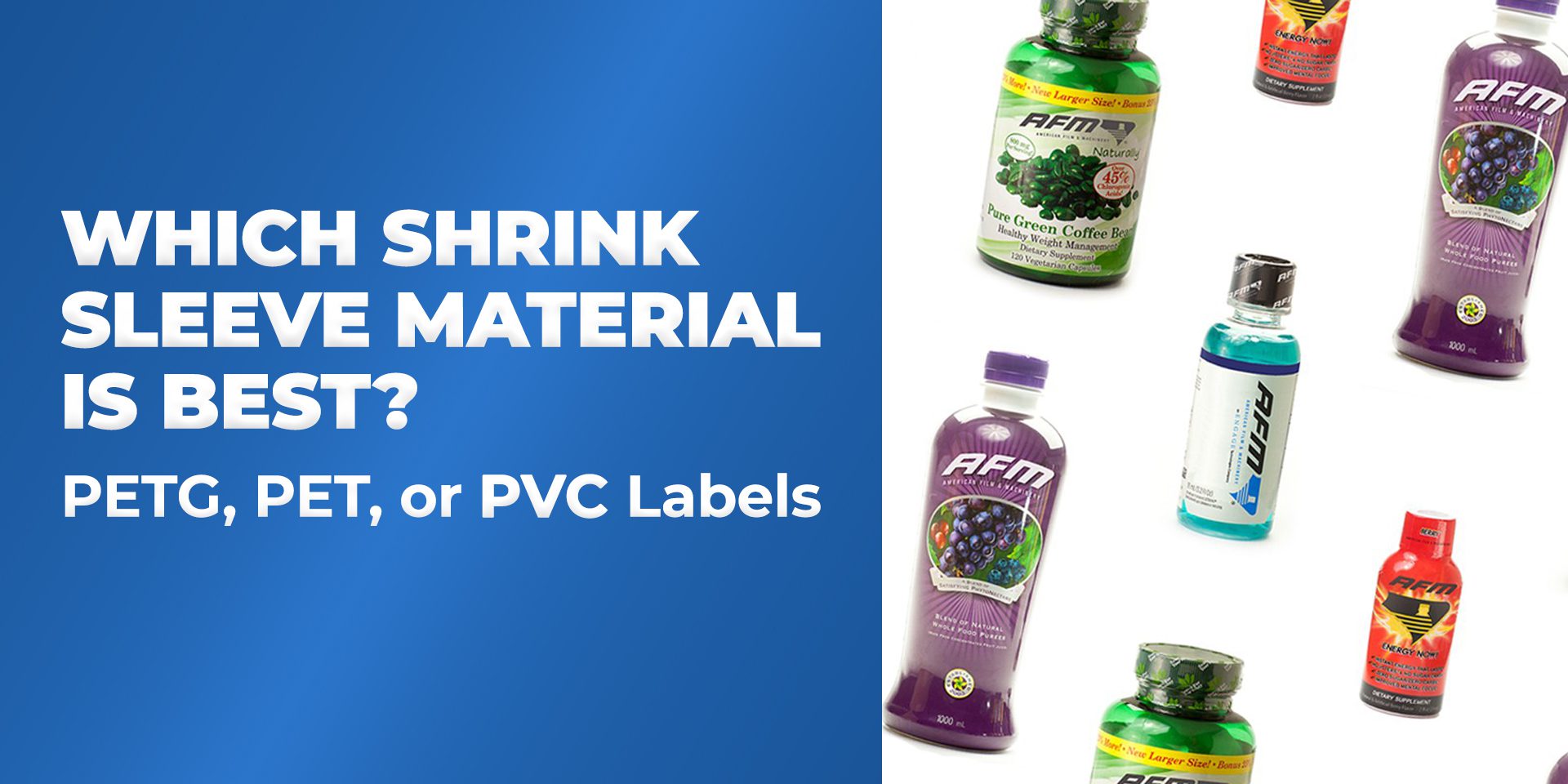
Which Shrink Sleeve Material Is Best: A Complete Guide to PETG, PET, PVC, PLA & OPS Labels
When it comes to high-impact packaging, shrink sleeve labels are one of the most versatile and visually powerful solutions available. Offering 360-degree branding, tamper evidence, and compatibility with complex container shapes, shrink sleeves are widely used across food, beverage, health, beauty, and household industries.
But one of the most common questions brands ask is:
Which shrink sleeve material is best — PETG, PET, PVC, PLA, or OPS?
The answer ultimately depends on your container design, budget, performance requirements, and sustainability goals. At AFM, we most commonly recommend PETG, PET, and PVC, with OPS used in select applications. In this guide, we’ll break down the three core materials – PETG, PET, and PVC – while also exploring PLA and OPS, giving you the insights needed to choose the best shrink sleeve solution for you packaging line.
What Are Shrink Sleeve Labels?
Shrink sleeve labels are printed plastic films that are applied over a container and then heat-shrunk to conform tightly to its shape. The material used determines:
- Shrink percentage and conformability
- Clarity and shelf appeal
- Material structure
- Cost
- Heat resistance
- Recyclability
Choosing the right material directly impacts both performance and brand positioning.
1. PETG (Polyethylene Terephthalate Glycol) Shrink Sleeves
Best for: Premium packaging solutions, high-performance and high-clarity labels
PETG is often viewed as the premium alternative to PET and PVC.
Benefits of PETG Shrink Sleeves:
- High shrink ratios (great for complex shapes), conforms tightly around curves
- Superior clarity and high-gloss finish
- Softer, more flexible material
- More expensive, but justified when high-quality shrink is required
- Shrinks at lower temperatures, works well with steam and hot air tunnels
- Can contaminate PET recycling if not separated
For brands prioritizing shelf appeal and sustainability messaging, PETG is a leading choice.
Considerations:
- Higher material cost than PET & PVC
- Requires proper recycling stream management but considered easier to recycle than PVC.
Ideal For: Premium beverages, personal care products, nutraceuticals, and brands that have proper recycling stream management.
2. PET (Polyethylene Terephthalate) Shrink Sleeves
Best for: Simple product shapes, durability, and food safety
PET is durable, ideal for scratch-resistant surfaces and food-safe packaging.
Benefits of PET Shrink Sleeves:
- Lower shrink ratios (best for straightforward bottle shapes)
- High gloss, very clear
- More rigid material, holds shape for simple wraps
- More cost effective than PETG
- Shrinks at higher temperatures and is less conforming in shrink tunnels than PETG
- Compatible with the standard PET bottle recycling stream, considered highly recyclable
Considerations:
- Highly recyclable
- Lower material cost than PETG but less conforming
Ideal For: Tamper evident bands and simple product shapes.
3. PVC (Polyvinyl Chloride) Shrink Sleeves
Best for: Cost-effective packaging and simple container shapes
PVC is one of the most widely used shrink sleeve materials in the packaging industry.
Benefits of PVC Shrink Sleeves:
- High shrink percentage, conforms tightly to irregular shapes
- Good clarity, glossy
- Cost-effective
- Shrinks at low temperatures
- Contains chlorine, difficult to recycle, and not sustainable
PVC works particularly well for straightforward bottle shapes and budget-conscious projects.
Considerations:
While PVC offers reliable performance, it is generally considered less environmentally friendly compared to newer materials like PETG and PET.
Ideal For: Beverage bottles, household products, and high-volume consumer goods where cost efficiency is critical.
What About OPS & PLA Films?
OPS (Oriented Polystyrene) shrink sleeves offer a balance of visual appeal and sustainability benefits, but they also come with notable trade-offs. OPS delivers excellent clarity and high gloss, with consistent and even shrink performance. It’s also generally considered a more environmentally favorable option compared to PVC.
However, these advantages come at a cost. OPS tends to be more expensive and has a lower shrink rate than materials like PETG or PVC, making it less ideal for highly contoured or complex container shapes. Additionally, its more brittle nature can increase the risk of cracking during handling and application.
Overall, OPS shrink films are a strong choice when clarity and sustainability are priorities, but they may present challenges in durability and cost compared to other options. At AFM, OPS films are commonly used in multi-pack shrink applications where their performance characteristics are well suited.
PLA (Polylactic Acid) shrink sleeves offer a sustainability-focused option, but they can present several practical challenges for manufacturers. Unlike PVC or PETG, PLA does not shrink as uniformly, which can increase distortion and wrinkling, particularly on complex container shapes. It also requires refrigerated, climate-controlled storage before and after application, adding both cost and operational complexity that can undercut its eco-friendly appeal.
From a cost perspective, PLA is generally one of the more expensive options. It is not fully biodegradable under typical conditions, and many recycling facilities are not equipped to properly sort or process it. On the production side, PLA’s softer composition can create handling and performance issues, and it is often less compatible with automated sleeving equipment—especially systems that rely on cutting knives.
Overall, while PLA offers a sustainable image, its practical limitations in shrink performance, handling, and processing make it a challenging choice for many production environments.
How to Choose the Best Shrink Sleeve Material
To determine which shrink sleeve material is best for your product, ask:
- What is your budget per unit?
- Does your container have complex curves or contours?
- Are sustainability goals a priority?
- Will the product be exposed to heat during transport or storage?
- Is recyclability or compostability required for your brand messaging?
There is no one-size-fits-all solution. The best shrink sleeve material depends on balancing cost, performance, design, and environmental considerations.
Final Thoughts: Which Shrink Sleeve Material Is Better?
- Choose PETG: Ideal for premium clarity, complex container shapes, and better alignment with recycling goals.
- Choose PET: Great for high clarity, simpler shapes, and recyclable packaging.
- Choose PVC: Affordable with strong all-around performance, though not a sustainable option.
- Choose PLA: Compostable and eco-conscious, suited for green packaging initiatives, yet presents challenges.
- Choose OPS: Lightweight and well-suited for multi-packs and food packaging applications.
By understanding the strengths and limitations of each material, you can select a shrink sleeve solution that enhances your product’s shelf presence while aligning with your operational and sustainability goals. Reach out to us at AFM to speak with experts on shrink films and your labeling needs.
